What Is Mechanical Descaling?
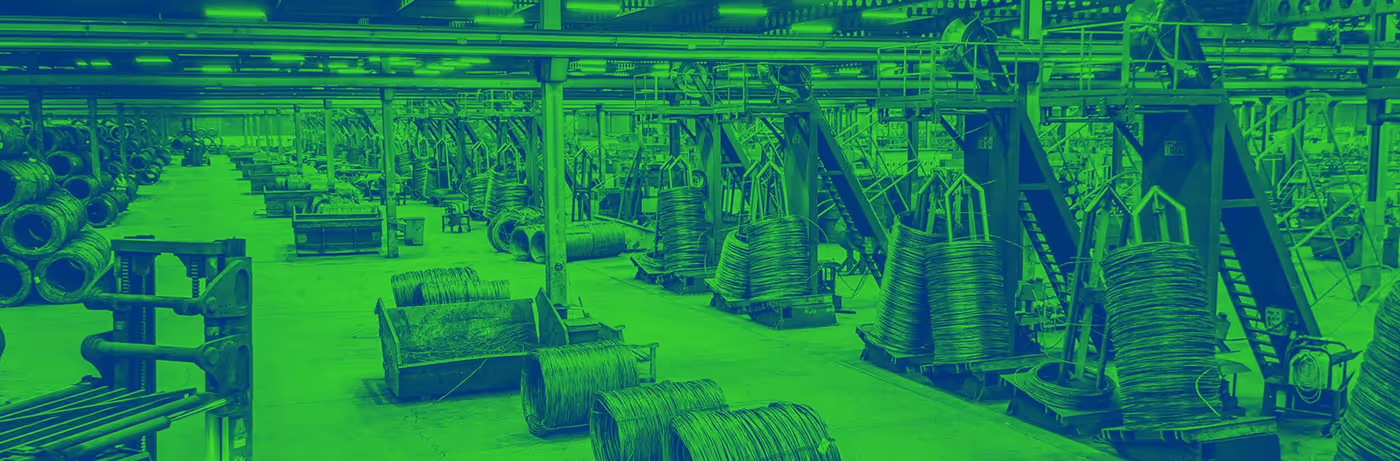
Hot rolled wire rod comes off the line covered in mill scale — a hard, carbon-rich oxide layer formed by the heat of rolling. It is harder than the steel underneath it, so if it isn’t removed, it damages the wire during further processing: it accelerates die wear, damages the wire surface, and costs you consistency in drawing.
Mechanical descaling removes it. No acid. No baths. Just mechanical force, applied directly on the line:
- Bending — cracks the scale off by flexing the rod in multiple directions
- Brushing — scrubs the wire clean with rotating brushes
- Sanding — grinds the surface to a fine, consistent finish
The result: a clean, “bright” wire, ready for drawing or coating — the sustainable way.
A Brief History of Mechanical Descaling
Wire manufacturers have used two main approaches to remove mill scale: chemical batch pickling and mechanical descaling.
From Batch Pickling to Mechanical Descaling (in-line)
Batch pickling — removing scale with acid baths — has itself evolved over the years. Automatically guided cranes and AGVs (automated guided vehicles) have made pickling lines less labour-intensive, but also more expensive to install and operate.
The Origins of Mechanical Descaling
Mechanical descaling by bending has an older, separate history. Its final descaling step — the sanding belt descaling machine — originates from the United States, developed by Webster and Morgan (known as WEBMORE or WEBMOR). WiTechs further developed this original concept to gain precise control over output quality, something the early machines could not consistently deliver.
Why Some Manufacturers Are Reconsidering Mechanical Descaling
Mechanical descaling is technically suitable for essentially all wire rod grades. In the past, however, the reputation of the technology suffered because the machines of that era weren’t advanced enough to guarantee consistent quality — leaving some manufacturers with negative experiences.
That is no longer the case. WiTechs’ machines are autonomous and actively monitor the process, so operators no longer influence output quality by hand — removing the main source of the inconsistency that damaged mechanical descaling’s reputation in earlier decades. As plant management teams turn over, more manufacturers are re-evaluating mechanical descaling on today’s technology rather than on outdated assumptions.
Why Mechanical Descaling Matters for Wire Quality
Scale left on the wire is abrasive. It wears your dies, breaks your wire, and shows up as defects downstream — especially in welding wire, spring wire, and anything headed for galvanizing or coating.
Descale mechanically, right before drawing or coating, and you get:
- Longer die life — less abrasive material through the dies
- Higher drawing speeds — a clean, activated surface, fewer breaks
- Better coating adhesion — coatings bond to a ‘avtivated’ surface
- Consistent quality — batch after batch, ton after ton
How Mechanical Descaling Works
Two stages for a clean wire: bending breaks off the bulk of the scale, then brushing or sanding finishes the job.
The Role of Bending in Scale Cracking
Wire rod runs over a series of rollers, bending back and forth across different planes. The scale is brittle — the steel isn’t. It cracks and drops off. This step does the heavy lifting, removing most of the scale before final descaling even starts. If bending descaling is not applied and only final descaling is used, the final descaling cannot effectively remove the scale because the scale layer has not been opened up. It remains as a continuous, film-like layer on the steel surface.
On its own, bending isn’t enough for a fully clean wire — that’s what final descaling is for.
Brushing and Sanding as Final Descaling Steps
After bending, the wire gets its final clean:
- Brush descaling — paired rotating brushes scrub the surface clean from every side
- Sanding belt descaling — abrasive belts grind the surface to a smooth, consistent finish, built for wider diameters and tougher scale
Both run as the final descaling step, right before drawing.
Mechanical Descaling Methods & Machine Types
Different diameters, different speeds, different requirements — different machines.
Bending Descaling
The preparation step. Wire rod runs over alternating rollers to crack and remove the bulk of the scale before final descaling. For most carbon wire rod, this step is a must — it makes everything downstream more efficient.
Brush Descaling
Frequency-controlled brushes that adjust automatically for wear, removing scale and activating the wire surface. Built for smaller and mid-range diameters, at high speed, at low cost. WiTechs’ Ecoclean and WBE are our brush descaling machines — each tuned for a different balance of speed, working range, and TCO.
Sanding Belt Descaling
Abrasive belts, ground against the wire, for a wider diameter range and tougher scale — coil-to-bar, cold heading, round-to-shape. WiTechs’ SEZ handles diameters up to 34 mm.
Shot Blasting
Used mainly for larger-diameter wire, bar, and profiles — abrasive media blasted at high velocity. Higher cost, higher capacity. More common for bar and billet descaling than the wire rod diameters WiTechs machines are built for.
Shot Blasting vs. Brushing and Sanding Belt Descaling: The Drawbacks
Compared to brushing and sanding belt descaling, shot blasting has several drawbacks for wire rod descaling: higher costs, more dust generation, less precision, greater risk of surface damage, and the need for more space and infrastructure — making brushing and sanding the more practical choice for smaller diameters and precision work.
Shot blasting is a powerful method for cleaning and descaling surfaces, but it isn’t always the most practical choice. Compared to brushing and sanding belt descaling, shot blasting has several notable drawbacks:
- Higher costs — Shot blasting requires specialized equipment, an enclosed workspace, and consumable blasting media. This makes investment and operating costs considerably higher than brushing or sanding.
- More dust and material contamination — Blasting releases fine dust and worn blasting media, requiring extra extraction, filtering, and clean-up. Brushing and sanding are more targeted and generate less particle dispersion.
- Less suited to precision work — Shot blasting typically treats a surface over a larger area, making it harder to target small or hard-to-reach spots. Brushing and sanding offer more control over the exact location and intensity of treatment.
- Risk of surface damage — At high pressure or with improper use, blasting media can damage the base material — pitting or uneven roughness — especially on thinner or softer materials. Brushing and sanding are generally gentler on the underlying material.
- More space and longer setup time — Shot blasting usually needs an enclosed space or cabin for safety and dust control, plus longer setup and teardown time than brushing or sanding — less efficient for smaller jobs or on-site work.
- Noise and dust nuisance — Shot blasting is generally louder and dustier, requiring extra personal protective equipment and measures compared to brushing or sanding.
Mechanical vs. Chemical Descaling
Both remove scale. Only one needs chemicals.
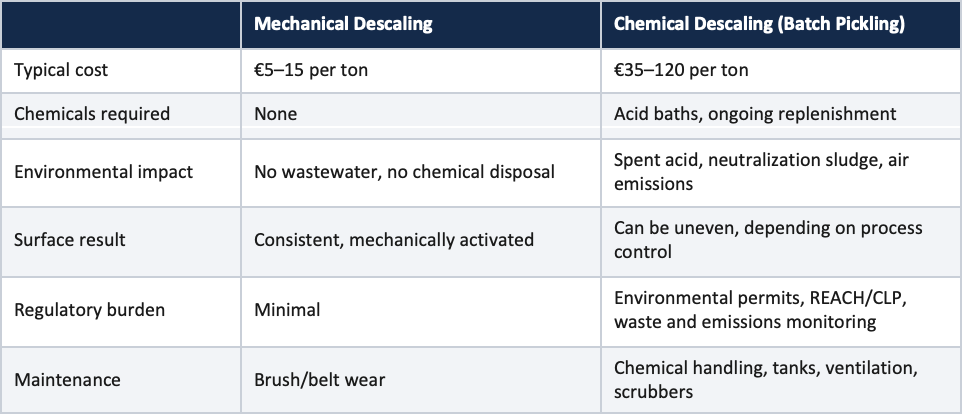
Mechanical descaling costs a fraction of chemical descaling — no chemicals to buy, replenish, or dispose of. And the surface is cleaner and more consistent, which means better coating adhesion downstream.
According to WiTechs’ internal process-cost analysis, switching from batch pickling to mechanical descaling typically saves €30–85 per metric ton — consistent with the cost ranges above.
That doesn’t mean mechanical always replaces chemical outright. It depends on your wire grade, your required finish, and your current line. But for a growing number of applications, mechanical descaling is the more cost-effective, more sustainable way to go.
Benefits of Mechanical Descaling
- Lower cost per ton — typical savings of €30–85 per ton versus batch pickling
- Reduced risk — less manual handling, no hazardous chemical baths
- Higher efficiency — drawing lines can run faster thanks to a mechanically activated surface
- No chemicals, no wastewater, no hazardous waste
- Consistent surface quality — stable drawing, better coating adhesion
- Less downtime — especially with automatic wear adjustment
- Lower long-term maintenance and regulatory burden than a chemical treatment line
Problems Mechanical Descaling Solves
- Die wear caused by scale particles in the drawing dies
- Inconsistent surface quality between batches
- Poor coating or galvanizing adhesion from residual scale
- The cost and environmental burden of chemical pickling lines
Mechanical Descaling for Different Wire Types
Mechanical descaling is technically viable for essentially every wire rod grade. The right machine sequence depends on the application — the table below shows typical in-line configurations. WiTechs reviews the best fit per application and process during a consultation.
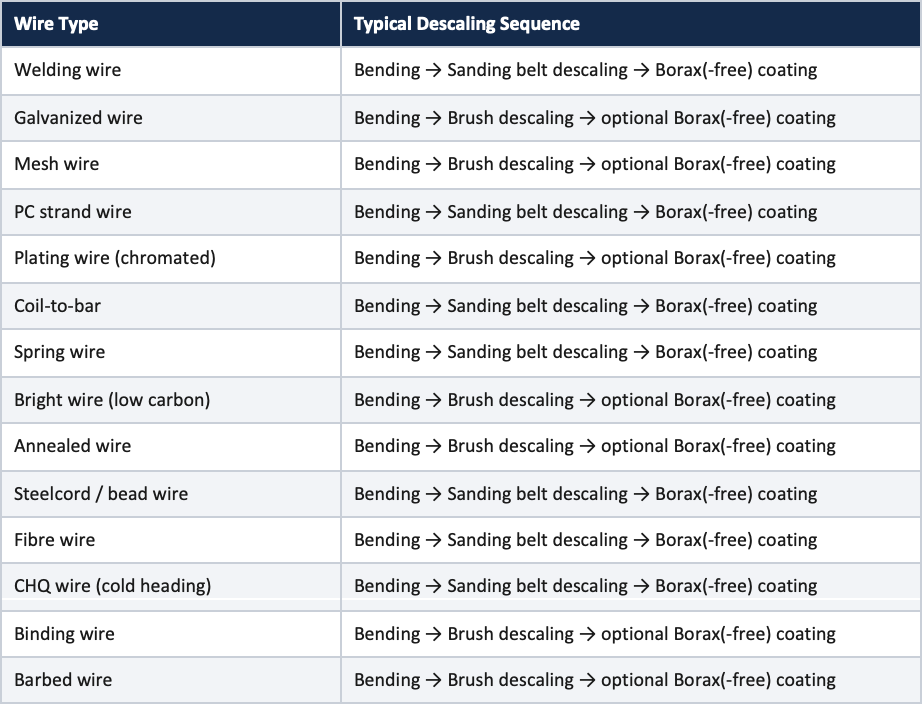
Diameter, scale severity, and required surface finish all influence the exact configuration — Calculate your savings for a recommendation tailored to your line.
Mechanical Descaling as an Inline Pre-Treatment Line
Mechanical descaling doesn’t stand alone. It’s one step in a complete inline pre-treatment line:
- 1. Wire pay-off — unwinds the wire rod into the line
- 2. Bending descaling — bulk scale removal
- 3. Final mechanical descaling — brushing or sanding
- 4. Coating — applied by the PCM coating machine (witechs.com/new-products/pcm/)
- 5. Drawing — down to final diameter
Built into the line, not bolted on after — less handling, less floor space, continuous flow from raw rod to finished, coated wire.
Regulatory & Compliance: Chemical vs. Mechanical Descaling
A company running chemical batch pickling takes on a wide range of environmental, safety, chemical, transport, and quality obligations. Exact requirements vary by country, but the main frameworks are broadly similar internationally. Mechanical descaling avoids most of this regulatory burden entirely, since no chemicals or hazardous waste streams are involved.
This overview is general information, not legal advice — requirements vary by jurisdiction and site; always confirm applicable obligations with local authorities or a qualified compliance advisor.
Environmental Permits
A batch pickling installation almost always requires an environmental permit covering air emissions (HCl vapours, acid aerosols), wastewater discharge, chemical storage, noise, hazardous waste, and soil protection. In the EU, the relevant frameworks include the Industrial Emissions Directive (IED 2010/75/EU), Best Available Techniques (BAT) Conclusions for the ferrous industry, the Water Framework Directive, and the Waste Framework Directive.
Chemical Regulations
Handling hydrochloric acid, sulphuric acid, inhibitors, and related chemicals brings extensive compliance obligations — in the EU, this includes REACH (EC 1907/2006) for registration, safe use, and Safety Data Sheets, and the CLP Regulation (EC 1272/2008) for labelling, hazard pictograms, and classification.
Occupational Safety
Workers on a pickling line are exposed to HCl, H₂SO₄, acid vapours, hot baths, lifting operations, and slippery floors. In Europe, this falls under the Occupational Safety and Health Framework Directive and the Chemical Agents Directive, typically requiring risk assessments, emergency and eye-wash stations, ventilation, gas detection, PPE, and training.
Machine Safety
Batch pickling lines include cranes, transport carts, automatic doors, drying ovens, and pumps — all subject to the EU Machinery Regulation, CE marking, EN ISO 12100, EN 60204-1, and lock-out/tag-out procedures.
Waste, Water, and Air Emissions
Key waste streams include spent acid, iron chloride, iron sulphate, neutralization sludge, and filter cakes, governed by hazardous waste regulations and the Basel Convention for international transport. Water discharge is typically controlled for pH, chloride, sulphate, iron, heavy metals, and COD, often requiring neutralization, filtration, and continuous monitoring. Air emissions — mainly HCl and acid mist — commonly require scrubbers and periodic or continuous emissions monitoring.
Transport, Quality, and ESG
Transporting acids is governed by international regulations (ADR for road, RID for rail, IMDG for sea, ICAO/IATA for air). On top of legal requirements, customers increasingly expect ISO 9001, ISO 14001, ISO 45001, and ISO 50001 certification, along with ESG reporting on CO₂, water and energy use, and waste recycling — in the EU, larger companies may also fall under the Corporate Sustainability Reporting Directive (CSRD).
What This Means in Practice
A compliant batch pickling operation typically needs closed acid tanks or effective vapour extraction, acid-resistant flooring with secondary containment, neutralization of process and rinse water, acid regeneration or treatment, scrubber-based extraction, spill and emergency procedures, and continuous monitoring of air and water emissions — on top of ISO 9001, ISO 14001, and ISO 45001 certification. Mechanical descaling avoids essentially all of this: no acid storage, no wastewater treatment, no scrubbers, and a substantially lighter permitting and compliance load.
WiTechs Mechanical Descaling Machines

Every machine is built for a different job. The right one depends on your diameter, your speed, and your TCO target. Pair any of them with the PCM Coating Machine for a complete inline pre-treatment line.
How to Choose the Right Mechanical Descaling Solution
- Wire diameter range — SEZ goes widest, up to 34 mm; Ecoclean and WBE are built for smaller diameters
- Line speed — Ecoclean runs fastest on smaller diameters
- Production volume — WBE runs up to 3,500 tons without downtime
- TCO target — cost per ton varies by machine, not just by method
- Wire grade and scale severity — tougher, high-carbon rod and coil-to-bar generally call for sanding belt descaling
Frequently Asked Questions
What is mechanical descaling?
Mechanical descaling removes mill scale and rust from steel wire rod using physical force — bending, brushing, or sanding — instead of chemicals.
How does mechanical descaling work?
Wire rod first passes through bending, which cracks off the bulk of the scale, then through final descaling — brushing or sanding — which removes what’s left and activates the surface.
What is the difference between mechanical and chemical descaling?
Mechanical descaling uses physical force and typically costs €5–15 per ton. Chemical batch pickling uses acid baths and typically costs €35–120 per ton — plus the wastewater, chemical handling, and regulatory obligations that come with it.
Is mechanical descaling more expensive than chemical descaling?
No. Mechanical descaling is significantly cheaper per ton, mainly because there are no chemicals to buy, replenish, or dispose of.
Which wire types can be mechanically descaled?
Welding wire, spring wire, mesh wire, galvanizing wire, chromated wire, barbed wire, CHQ wire, and coil-to-bar applications, among others.
What is the difference between brush descaling and sanding belt descaling?
Brush descaling runs rotating brushes at high speed on smaller to mid-range diameters. Sanding belt descaling grinds with abrasive belts, covering a wider diameter range and tougher scale conditions.
Can mechanical descaling fully replace chemical descaling?
In many applications, yes — particularly where cost and sustainability matter. The right choice still depends on wire grade and required finish.
How does mechanical descaling affect die wear in wire drawing?
Less abrasive scale through the dies means slower wear and more stable, consistent drawing.
What wire diameters can WiTechs machines process?
4 mm up to 34 mm across the range: Ecoclean and WBE for smaller diameters, SEZ up to 34 mm.
How do I calculate the ROI of a mechanical descaling machine?
It comes down to reduced downtime, extended die lifetime, and TCO versus your current method. Calculate your savings (witechs.com/configurator/) for a tailored estimate.
Where does mechanical descaling technology come from?
Sanding belt descaling originates from the United States, first developed by Webster and Morgan (WEBMORE/WEBMOR). WiTechs further developed the concept to give manufacturers precise control over output quality.
How much does batch pickling (chemical descaling) cost per ton?
Batch pickling typically costs €35–120 per metric ton, depending on wire grade, batch size, and local chemical and labour costs — substantially more than mechanical descaling.
What environmental regulations apply to chemical batch pickling of wire?
In the EU, batch pickling operations typically fall under the Industrial Emissions Directive, REACH and CLP chemical regulations, and waste and water discharge rules, and usually require an environmental permit. Requirements vary by country — this is general information, not legal advice.
Does mechanical descaling require an environmental permit?
Mechanical descaling avoids the acid storage, wastewater treatment, and air emissions that typically trigger environmental permitting for batch pickling, which significantly reduces the regulatory burden — though local requirements should always be confirmed.